
The Tiger’s Nest hike is a 6-8 km (3.7-5 mile) round trip from the trailhead near Paro, climbing about 520 m (1,700 ft) to the monastery at 3,120 m (10,232 ft). Most people take 2-3 hours up, 1.5-2 hours down and 5-7 hours in total including the temple visit. It is a moderate day hike – steep and sustained but not technical – that most reasonably active adults finish comfortably.
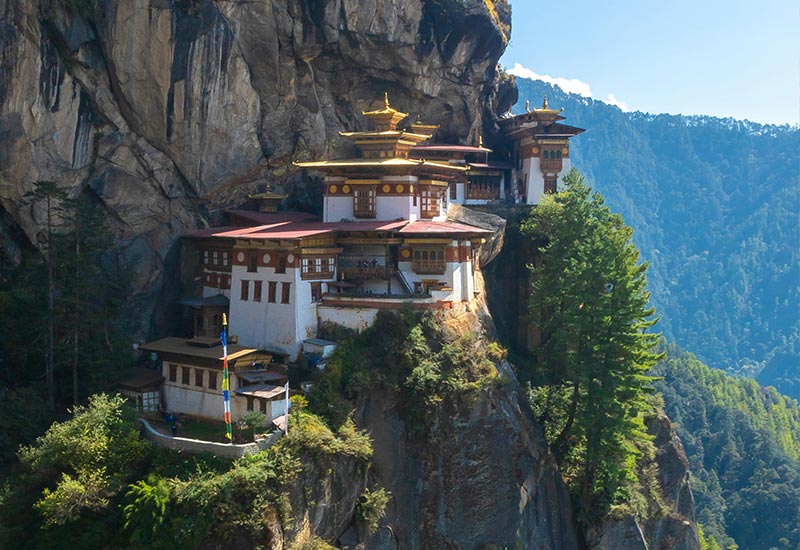
Paro Taktsang, the Tiger’s Nest, clings to a granite cliff roughly 900 m (2,950 ft) above the Paro Valley in western Bhutan, and the only way in is on foot. For most travelers it is the last, defining day of a Bhutan tour. Online stats for this trail disagree wildly, so this guide breaks it down the way our guides actually walk it – section by section, with real numbers.
How far is the Tiger’s Nest hike?
The round trip is 6-8 km (3.7-5 miles). The figure most guides work with is about 6.4 km (4 miles); the higher numbers come from taking the wide pony track instead of footpath shortcuts, or from adding viewpoint detours.
You start at the Ramthangkha trailhead car park, about 10 km (a 20-minute drive) north of Paro town, at roughly 2,600 m (8,530 ft). The monastery sits at 3,120 m (10,232 ft), so the net climb is about 520 m (1,700 ft).
The cumulative climb is higher – closer to 600-700 m (1,970-2,300 ft) – because the final approach drops into a gorge and climbs back out. That last detail is the one most trail summaries leave out.
How is the trail broken into sections?
| Section | Distance | Time | Climb |
| Trailhead – Cafeteria | 2 km | 1-1.5 hrs | ~330 m (1,080 ft) |
| Cafeteria – Viewpoint | 1 km | 45-60 min | ~180 m (590 ft) |
| Viewpoint – Monastery | 0.3 km | 15-25 min | Steps down, then up |
| Return | 3.2 km | 1.5-2 hrs | Downhill |
The first section is dusty switchbacks through blue pine, shared with ponies, and it is the steepest sustained climb. Beyond the cafeteria the path narrows under prayer flags to the viewpoint, then several hundred stone steps drop to a waterfall bridge before climbing to the gate.
Why do online numbers disagree so much?
- Different start points: some trackers start at the lower road, adding several hundred meters each way.
- Pony track vs shortcuts: the broad, gentler pony track zigzags far more than the steep footpath that cuts across it.
- GPS overcounting: watches routinely add 10-20% on tight switchbacks, which is how 8+ km figures appear.
- Optional detours: the hill above the viewpoint and the small temples near the gorge each add distance and height.
Our guides tell guests to plan around 6.5 km and 600 m of total climbing. If your watch says more at the end of the day, that is normal.
How long does it take to hike to Tiger’s Nest?
Plan on 5-7 hours from trailhead and back: 2-3 hours up, 45-60 minutes inside the monastery, and 1.5-2 hours down. Add 45 minutes if you stop for lunch at the cafeteria on the way down.
| Hiker | Ascent | Total day |
| Fit hiker | 1.75-2 hrs | 4-5 hrs |
| Active non-hiker | 2.5-3 hrs | 5-6 hrs |
| Slower pace | 3-3.5 hrs | 6-7 hrs |
| Pony + hike | 2-2.5 hrs | 5-6 hrs |
Descents run 1-2.5 hours depending on your knees more than your lungs. Pony riders save roughly an hour on the way up but walk the entire way down, so their total day ends up close to that of an active hiker on foot.
Timing also depends on the monastery’s hours. It opens at 8 a.m., closes for lunch from 1 to 2 p.m., then reopens until 5 p.m. from October to March and 6 p.m. from April to September.
Arrive at the gate at 12:50 and you wait over an hour. Hours occasionally shift for religious events, so confirm them with your guide the evening before.
What does a typical hike day look like?
- 7:00 a.m. – breakfast in Paro, then a 20-minute drive to the trailhead
- 7:45 a.m. – start walking; ponies leave from the same car park
- 9:00 a.m. – short break at the Taktsang Cafeteria for tea and the first close view
- 10:00 a.m. – main viewpoint, photos, then the steps down to the waterfall and up to the gate
- 10:30-11:30 a.m. – lockers, then the guided visit through the shrine rooms
- 12:30 p.m. – lunch at the cafeteria on the way down
- 2:30 p.m. – back at the trailhead, with the afternoon free in Paro
A hot stone bath at a Paro farmhouse that evening is the traditional way to finish, and your legs will thank you the next morning.
Guide tip We aim to leave the trailhead by 7:30-8:00 a.m. That puts you at the monastery around 10:30, well before the lunch closure, and on the exposed lower switchbacks before the sun hits them.

How difficult is the Tiger’s Nest hike?
Moderate. It is steep and sustained, with real altitude and several hundred stone steps, but there is no scrambling, no technical ground and no overnight stay. Most active adults who walk regularly finish it comfortably.
What makes it harder than it looks?
- Altitude: 3,120 m (10,232 ft) is high enough to leave you breathless on the steeper pitches, especially if you flew straight into Paro (2,200 m / 7,200 ft) and hiked the next day.
- Sustained grade: the first section climbs almost without a break for 1-1.5 hours. There is no flat warm-up.
- The stairs: after the viewpoint you descend to a waterfall bridge, then climb back up to the gate. On the way out, you do it again in reverse – tired.
- The descent: dry, gravelly switchbacks are slippery underfoot and punish knees more than the ascent punishes lungs.
Most first-time hikers underestimate the steps after the viewpoint. They see the monastery directly across the gorge, assume they have arrived, and spend their last energy on photos.
Who finds it hardest?
- Travelers who do little regular walking and attempt the hike on day one or two in Bhutan
- Anyone with knee problems – the descent is the crux, not the climb
- People uneasy with heights: railings line the exposed sections, but the stairs on the cliff face feel airy
- Visitors with heart or lung conditions – check with your doctor about exertion at 3,000 m (9,840 ft) before you travel
How should you prepare?
Four to six weeks of prep is plenty. Two or three sessions a week of brisk uphill walking, stair climbing or a stair machine for 45-60 minutes will cover it.
If you can walk 10-12 km (6-7.5 miles) on hilly ground at home without feeling wrecked the next day, you are ready. Practise downhill too, ideally with trekking poles. Schedule the hike for late in your Bhutan trip, after a few days in Thimphu (about 2,320 m / 7,610 ft) and Paro, so your body has adjusted.
How does it compare with popular Nepal hikes?
| Hike | High point | Time | Effort |
| Tiger’s Nest | 3,120 m (10,232 ft) | 5-7 hrs | Moderate |
| Poon Hill (Nepal) | 3,210 m (10,531 ft) | 1 hr up | Easy |
| Namche day (Nepal) | 3,440 m (11,286 ft) | 6-7 hrs | Moderate-hard |
For scale, the Poon Hill sunrise climb gains about 350 m (1,150 ft) from Ghorepani, while the Namche Bazaar day on the Everest trail gains about 800 m (2,620 ft).
If you have done the Poon Hill sunrise climb, Tiger’s Nest is a longer, steadier version of the same effort. If you are combining both countries, our guide to the best short treks in Nepal lists routes at a similar level.
Is altitude sickness a risk on the Tiger’s Nest trail?
The risk is low but not zero. At 3,120 m (10,232 ft), serious altitude illness is rare on a single day hike, but headaches, breathlessness and nausea are common in visitors who climb within 24-48 hours of landing.
- Spend at least 2-3 nights at 2,200-2,400 m (7,200-7,900 ft) in Paro and Thimphu before the hike
- Walk at a pace where you can still hold a conversation, and rest before you are exhausted
- Drink steadily and skip alcohol the night before
- Turn back if a headache worsens or you feel dizzy or confused – the cafeteria view is still worth the walk
Symptoms on this trail almost always ease within an hour of descending. If you have trekked in Nepal recently, you will already be well adapted.
Should you hike, ride a pony or stop at the cafeteria?
Hike the whole way if you can walk uphill for 2-3 hours with rests. If not, a pony to the cafeteria removes the steepest third of the climb, and the cafeteria itself has one of the best views of the monastery.
| Option | Best for | You walk |
| Full hike | Most active adults | Everything |
| Pony + hike | Weak knees, low fitness | Top half + descent |
| Cafeteria only | Limited mobility | ~2 km round trip |
Stopping at the cafeteria gives you the classic view, but you don’t enter the monastery.
Ponies wait at the trailhead and cost roughly Nu 700-1,200 (about USD 8-14) one way, paid in cash. They only go as far as the cafeteria – the trail beyond is too narrow and stepped – and they are not used for the descent.
Our guides recommend booking the pony first thing rather than mid-morning, when the queue builds. Bhutanese tradition also holds that a rider shares the merit of the pilgrimage with the horse, which locals like to mention as you climb.
When is the best time to hike Tiger’s Nest?
October-November and March-April are the best months: dry trails, comfortable daytime temperatures and the clearest views of the cliff. The trail is open all year, so the real choice is between crowds, clouds and cold.
| Season | Months | Verdict |
| Autumn | Sep-Nov | Best; busiest in Oct |
| Spring | Mar-May | Excellent; flowers |
| Monsoon | Jun-Aug | Wet, cloudy, quiet |
| Winter | Dec-Feb | Clear, cold, quiet |
Autumn brings the driest trail and the sharpest light on the cliff, but October is also peak season, so the steps near the gate can queue. Spring is nearly as good: rhododendrons flower along the upper path in March and April, though haze often softens the valley views by May.
In the monsoon, the stone steps near the waterfall stay wet all day and the lower track turns to mud after heavy rain. Allow an extra hour, wear boots with real grip and carry a rain shell; winter hikers should add gloves and a warm hat for the shaded upper section.
Festival dates, flight availability and hotel demand all shift with the season – our guide to the best time to travel to Bhutan covers the wider picture.
In October we start at the trailhead before 8 a.m. Most tour groups arrive between 9 and 10, and the steps near the gate become a single-file queue by late morning.
How much does the Tiger’s Nest hike cost?
The monastery entrance fee is Nu 1,000 (about USD 11-12) per adult. That is the only charge specific to the hike, and it is usually included in a Bhutan tour package.
| Item | Cost (2026) |
| Taktsang entry | Nu 1,000 (~USD 12) |
| Pony (optional) | Nu 700-1,200 (~USD 8-14) |
| SDF | USD 100 / night |
| Bhutan visa | USD 40 (one-off) |
| Cafeteria lunch | Usually included |
Children aged 6-18 usually pay half the entry fee and under-5s enter free. The SDF rate is confirmed through 31 August 2027, with ages 6-11 paying half.
The SDF and visa are not hike-specific, but you cannot reach the trailhead without them. Since January 2026, a 5% GST also applies to tour components such as hotels and guiding, though not to the SDF.
Fees in Bhutan change with little notice – the Taktsang fee itself was halved from Nu 2,000 in 2023. Prime Himalayas confirms current fees at the time of booking, so the figures in your quote are the ones you pay.
What should you wear and bring on the hike?
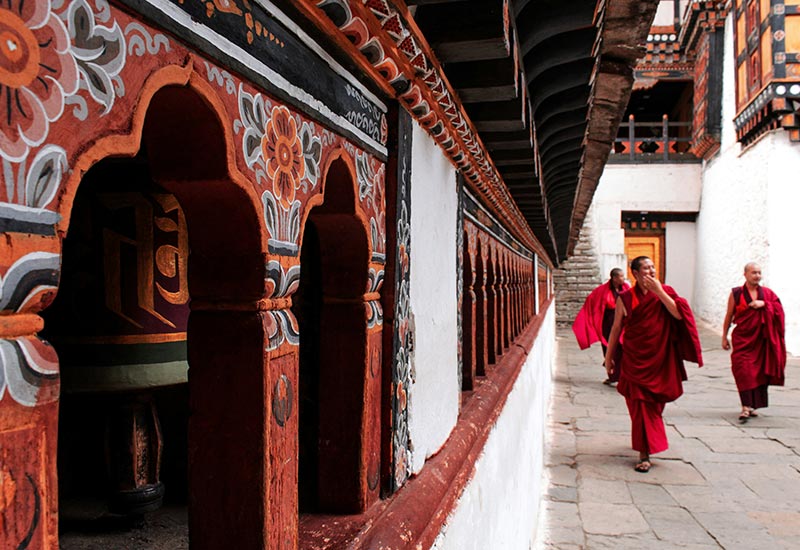
Wear modest, layered clothing and good hiking shoes, and carry water, cash and poles. Remember that bags, phones and cameras are not allowed inside – you leave them in lockers at the entrance.
Monastery dress code
- Long sleeves and long trousers or a skirt below the knee – no shorts, vests or sleeveless tops
- Hats and sunglasses off inside; shoes off in the shrine rooms
- Your guide will wear a formal kabney (ceremonial scarf) and handle the entry process
Daypack checklist
- 1-1.5 liters of water per person (refills are limited after the cafeteria)
- A light fleece or windproof layer – the monastery is cooler and breezier than the trailhead
- Trekking poles or a walking stick, sold or rented cheaply at the trailhead
- Sunscreen, sunglasses and a cap for the open lower switchbacks
- Small Bhutanese ngultrum notes for the pony, tea and butter-lamp offerings
- A light snack – the cafeteria is the only food stop on the trail
Our guides insist on poles for the descent. Guests who skip them on the way up often borrow one on the way down.
What will you see inside the Tiger’s Nest monastery?
A cluster of small, candlelit temples built around the cave where Guru Rinpoche is said to have meditated in the 8th century. Legend says he flew here on the back of a tigress, which gives the monastery its name.
The current complex dates from 1692, was badly damaged by fire in 1998 and restored by 2005. Inside you will pass through several shrine rooms; your guide explains the murals and statues, and you can offer a butter lamp.
Plan 45-60 minutes inside. The visit is quiet and unhurried, and for many guests it matters more than the hike itself.
Monks still live and practise here, so voices stay low and you walk clockwise around the shrines. If a ceremony is under way, your guide may wait for a break before leading you in – another reason to arrive with time in hand.
Where are the best photo spots?
- Cafeteria terrace: the classic wide shot of the monastery on its cliff, best in mid-morning light
- Main viewpoint: the closest face-on view, framed by prayer flags
- Waterfall bridge: looking up at the monastery walls from directly below
Photography is fine anywhere on the trail but not inside the temples, which is why phones go into the lockers. Take your photos before you reach the gate.
Where does the Tiger’s Nest hike fit in a Bhutan itinerary?
Put it near the end of your trip, the day before you fly out of Paro. By then you have spent several days above 2,000 m (6,560 ft) in Thimphu and Paro, and the climb feels noticeably easier.
A typical 5-7 day western Bhutan loop runs Paro – Thimphu – Punakha – Paro, with Taktsang on the second-to-last day. Our guide to the best places to visit in Bhutan shows what else to fit around it.
Many travelers pair Bhutan with Nepal, since Kathmandu has direct flights to Paro. Our Nepal and Bhutan tour follows this pattern, with Prime Himalayas guides handling permits, timing and the Taktsang day end to end.
Frequently asked questions
Most people need 5-7 hours in total: 2-3 hours up, 45-60 minutes in the monastery and 1.5-2 hours down. Fit hikers can finish in about 4-5 hours; slower walkers should allow the full 7.
Yes, if they can walk uphill for 2-3 hours with rests. Beginners should hike late in their trip, start early and use poles, or take a pony to the cafeteria to save energy for the steps.
No. International visitors to Bhutan must travel with a licensed Bhutanese guide, who accompanies you on the trail and inside the monastery.
No. Ponies only carry riders uphill as far as the cafeteria, roughly halfway. Everyone walks the descent.
Children aged about 8 and up who are used to walking usually manage the full hike. Younger children can ride a pony to the cafeteria, and kids under 5 enter the monastery free.
Yes, at the Taktsang Cafeteria, roughly halfway up. Use them on the way past, because facilities beyond that point are limited.
Walk Taktsang With a Local Guide
Our Bhutan guides time the climb around the monastery’s hours, book your pony early and know every rest stop on the trail. Combine Tiger’s Nest with Thimphu, Punakha and Kathmandu on one seamless trip.