
Poon Hill is the better short trek near Pokhara for first-timers, families and anyone with 3-4 days: it tops out at 3,210 m (10,531 ft) and you never sleep above 2,900 m. Mardi Himal is the better choice for fit trekkers who want a quieter ridge walk and a close-up of Machhapuchhre from 4,500 m (14,764 ft) in 5 days. Both start within 90 minutes of Pokhara and use the same permit.
Poon Hill vs Mardi Himal is the decision most trekkers face when they have a week or less in the Annapurna region. Both routes begin a short drive from Pokhara, both use teahouses, and both sit inside the Annapurna Conservation Area.
The difference is height and character. One is a stone-stepped village loop to a famous sunrise viewpoint; the other is a forest-and-ridge climb to a base camp. This comparison covers difficulty, days, cost, views, permits and season.
What Is the Difference Between Poon Hill and Mardi Himal?
Poon Hill is a lower, busier village trek built around one sunrise viewpoint. Mardi Himal is a higher, quieter ridge trek that finishes at a base camp almost 1,300 m (about 4,230 ft) above Poon Hill’s summit.
| Factor | Poon Hill | Mardi Himal |
| Highest point | 3,210 m (10,531 ft) | 4,500 m (14,764 ft) at Base Camp |
| Highest night’s sleep | Ghorepani, about 2,860 m (9,383 ft) | High Camp, about 3,580 m (11,745 ft) |
| Trekking days from Pokhara | 3-5 days | 4-6 days |
| Walking per day | 4-6 hours | 5-7 hours; 8-9 on Base Camp day |
| Difficulty | Easy to moderate | Moderate, with one hard day |
| Trail character | Stone steps, villages, rhododendron forest | Forest trail, then exposed ridge |
| Drive from Pokhara | About 1.5 hours to Nayapul | 1-1.5 hours to Kande |
| Crowds | Busy in Oct-Nov and Mar-Apr | Moderate and growing |
| Guided cost from Pokhara | USD 280-800 | USD 300-600 |
| Best for | First-timers, families, tight schedules | Fit trekkers wanting altitude and quiet |
If neither sounds quite right, our roundup of the best short treks in Nepal covers the wider field beyond the Annapurna foothills.
Which Trek Is Easier: Poon Hill or Mardi Himal?
Poon Hill is easier. Its hardest section is a staircase rather than thin air, and the trail is wide, well marked and lined with lodges every hour or so.
How hard is the Poon Hill trek?
The effort on Poon Hill comes in three short bursts:
- The Ulleri staircase: roughly 3,300 stone steps from Tikhedhunga to Ulleri, about 2 hours of steady climbing.
- The sunrise climb: around 350 m (1,150 ft) of ascent from Ghorepani to the viewpoint, 45-60 minutes by headlamp.
- The descent to Ghandruk: long stone stairways that test knees more than lungs.
A jeep track now reaches Ulleri, so trekkers short on time or wary of the steps can drive past them and finish the loop in 3 days.
Guide tip: Our guides tell first-time trekkers to treat the Ulleri steps as a two-hour job with a tea stop halfway. People who race it usually pay for it on the way up to Ghorepani the next morning.
How hard is the Mardi Himal trek?
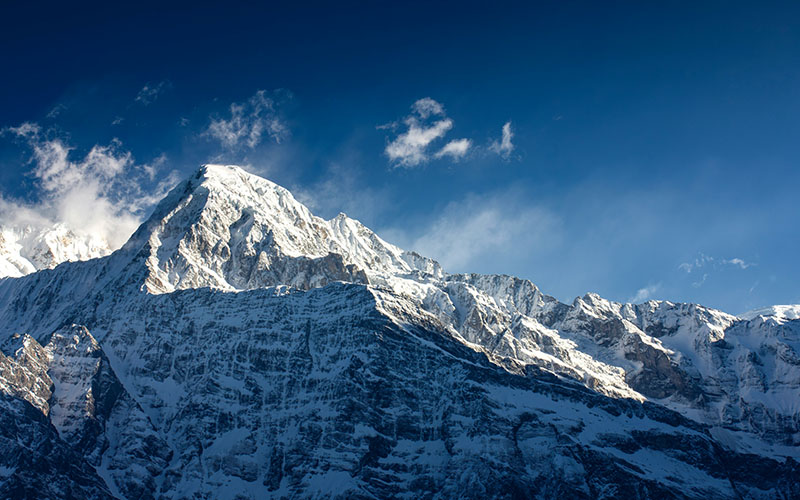
Mardi Himal is a moderate trek with one demanding day. The forest stages are steady, but the path is narrower than Poon Hill’s, with more roots, mud and loose rock.
- Low Camp to High Camp: the steepest sustained climb, mostly above the tree line and open to wind.
- Base Camp day: a pre-dawn start, about 920 m (3,020 ft) of ascent, and 5-7 hours on the ridge before you drop to Low Camp.
- The exit: nearly 1,900 m (about 6,200 ft) of descent from High Camp to Sidhing across a day and a half.
Most first-time trekkers underestimate that descent. Lungs recover within minutes of losing height; quads and knees take two days.
How Many Days Do You Need for Each Trek?
Plan 4-5 trekking days for Poon Hill and 5 for Mardi Himal, Pokhara to Pokhara. Add 2-3 days if your trip starts and ends in Kathmandu.
Poon Hill: classic 5-day loop
- Drive Pokhara to Nayapul, trek to Ulleri via Tikhedhunga
- Ulleri to Ghorepani (2,860 m / 9,383 ft) through rhododendron forest
- Sunrise on Poon Hill (3,210 m / 10,531 ft), then on to Tadapani (2,630 m / 8,629 ft)
- Tadapani to Ghandruk (1,940 m / 6,365 ft), the largest Gurung village on the route
- Ghandruk to Nayapul, drive back to Pokhara
Mardi Himal: standard 5-day route
- Drive Pokhara to Kande, trek to Pitam Deurali (2,125 m / 6,972 ft) via Pothana
- Pitam Deurali to Low Camp (2,970 m / 9,744 ft) via Forest Camp
- Low Camp to High Camp (3,580 m / 11,745 ft) via Badal Danda
- Pre-dawn climb to the Upper Viewpoint (4,200 m / 13,780 ft) or Base Camp (4,500 m / 14,764 ft), descend to Low Camp
- Low Camp to Sidhing (1,700 m / 5,577 ft), jeep to Pokhara
Prime Himalayas runs both as 9-day Kathmandu-to-Kathmandu trips with 5 days on the trail: the Ghorepani Poonhill Sunrise Trek and the Mardi Himal Trek.
Fit trekkers can do Mardi Himal in 4 days by combining the first two stages. A 3-day version exists, but it means sleeping at High Camp on the second night with almost no time to adjust.
Guide tip: Our guides advise against the 3-day Mardi schedule for anyone who has flown in from sea level that week. The extra night at Low Camp is the cheapest insurance on the route.
Which Trek Has Better Mountain Views?
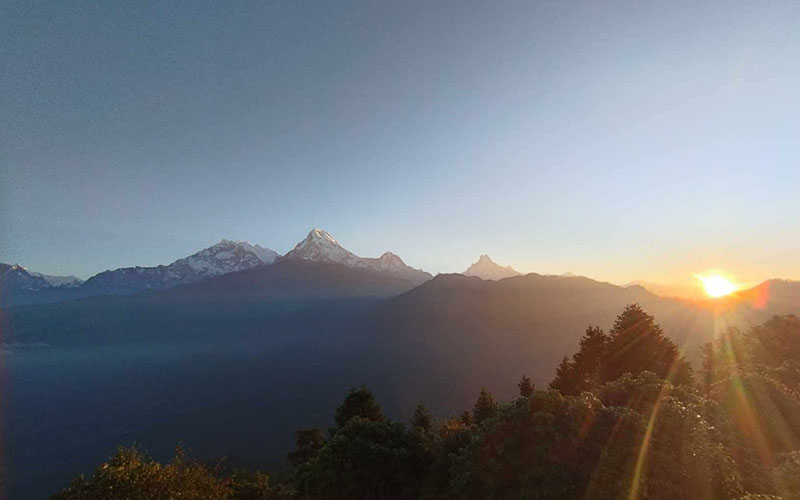
Poon Hill gives the wider panorama; Mardi Himal gives the closer one. The Poon Hill vs Mardi Himal views question really comes down to whether you want two 8,000 m peaks in one frame or a single mountain filling the sky.
The view from Poon Hill
From the tower at 3,210 m you look across a deep valley at Dhaulagiri (8,167 m / 26,795 ft) and Annapurna I (8,091 m / 26,545 ft), with Annapurna South, Nilgiri and Machhapuchhre along the same skyline.
It is a sunrise view. You arrive in the dark, watch the light move across the range for 30-40 minutes, and walk down for breakfast. In October you share it with a large crowd.
The view from the Mardi Himal ridge
On Mardi Himal the mountains stay with you for a day and a half. From Badal Danda upward, the ridge runs straight toward Machhapuchhre (6,993 m / 22,943 ft) and Annapurna South (7,219 m / 23,684 ft).
Mardi Himal itself (5,587 m / 18,330 ft) sits directly ahead at Base Camp. One detail trekkers enjoy: Badal Danda, a mid-ridge lodge stop, stands at about the same height as Poon Hill’s summit.
Guide tip: On Poon Hill, leave your Ghorepani lodge by 4:30 a.m. in peak season. Arrive later and you will be watching the sunrise over other people’s shoulders.
How Much Does Each Trek Cost in 2026?
From Pokhara, a guided Poon Hill trek costs roughly USD 280-800 per person and a guided Mardi Himal trek USD 300-600, depending on days, group size and whether you take a porter. On price, Poon Hill vs Mardi Himal is close to a draw.
| Cost item | Poon Hill | Mardi Himal |
| ACAP permit | NPR 3,000 (about USD 20-25) | NPR 3,000 (about USD 20-25) |
| TIMS card, where applied | NPR 2,000 (about USD 15) | NPR 2,000 (about USD 15) |
| Licensed guide | USD 25-30 per day | USD 25-30 per day |
| Porter (carries for two) | USD 15-20 per day | USD 15-20 per day |
| Teahouse room | USD 3-8 per night | USD 3-8 per night |
| Meals | USD 15-25 per day | USD 15-25 per day, more at High Camp |
| Guided total from Pokhara | USD 280-800 (3-7 days) | USD 300-600 (4-5 days) |
Our 9-day Kathmandu-to-Kathmandu packages start from USD 999 for Poon Hill and USD 799 for Mardi Himal on a twin-share basis. Both include hotels, permits, a licensed guide, one porter per two trekkers and the Pokhara-Kathmandu flight.
Budget separately for the items no package covers:
- Hot showers, device charging and Wi-Fi at lodges
- Snacks, bottled or filtered water and drinks
- Tips for your guide and porter, and travel insurance
Carry Nepali rupees from Pokhara, because neither trail has a dependable ATM. For a wider budget picture, see our guide to how much it costs to trek in Nepal.
What Permits Do You Need for Poon Hill and Mardi Himal?
Both treks need the same paperwork: the Annapurna Conservation Area Permit (ACAP), which costs NPR 3,000 (about USD 20-25) for foreign nationals. Neither route requires a restricted area permit.
- ACAP: NPR 3,000 for foreigners and NPR 1,000 for SAARC nationals. It is issued in Kathmandu or Pokhara, valid for a single entry, and charged at double the rate if you buy it at a trail checkpost.
- TIMS card: NPR 2,000 for foreign nationals. It remains on the official list, but 2026 reports conflict on whether Annapurna checkposts still ask for it.
- Licensed guide: a Nepal Tourism Board rule in force since April 2023 requires foreign trekkers to walk with a licensed guide booked through a registered agency. Enforcement inside the conservation area has been uneven.
Permits are checked at Birethanti and Ghorepani on the Poon Hill loop and at Pothana on the Mardi Himal approach. Carry the paper copy and your passport.
| Verify before you travel: Annapurna permit rules have shifted more than once since 2023, and published sources disagree on TIMS and guide enforcement for 2026. Prime Himalayas’ permit team confirms the current position for every booking; if you are arranging permits yourself, check with the Nepal Tourism Board office in Pokhara before you set out. |
How Serious Is the Altitude on Each Trek?
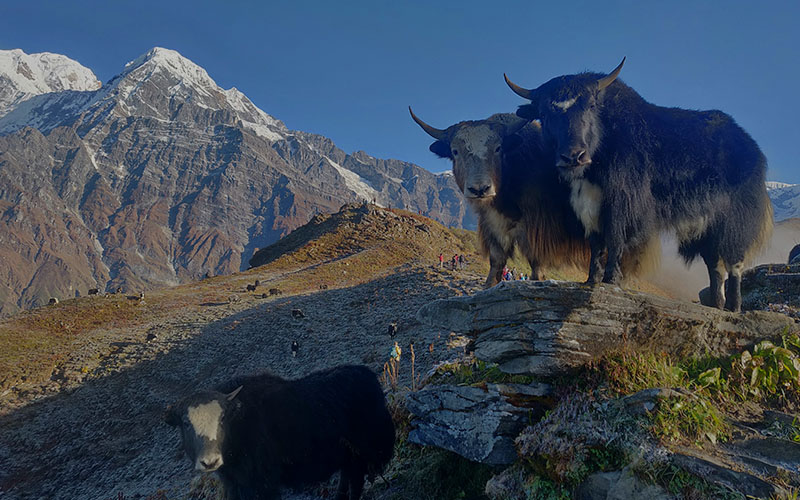
Altitude is a minor factor on Poon Hill and a real one on Mardi Himal. Acute mountain sickness (AMS) can begin above roughly 2,500 m (8,200 ft), and Mardi Himal keeps you above that line for two nights and one long day.
- Poon Hill: one night at 2,860 m and about an hour at 3,210 m. A mild headache at Ghorepani is the most that the majority of trekkers notice.
- Mardi Himal: nights at 2,970 m and 3,580 m, then a climb to 4,500 m. The 610 m (2,000 ft) jump in sleeping height between Low Camp and High Camp is more than the 300-500 m per day usually advised above 3,000 m.
The saving grace on Mardi Himal is that you descend to Low Camp the same day you reach the top. Stopping at the Upper Viewpoint (4,200 m / 13,780 ft) is a perfectly good finish if anyone in your group feels rough.
Guide tip: We set a 9 a.m. turnaround on the Base Camp ridge. Cloud usually rises from the valley by mid-morning, and that narrow path is no place to be walking in a whiteout.
Trekking with children or older parents? The lower sleeping heights are a large part of why Poon Hill works so well for families.
When Is the Best Time for Poon Hill and Mardi Himal?
October-November and March-April are the best months for both treks. Poon Hill stays workable for more of the year because its trail and lodges sit about 700 m (2,300 ft) lower.
| Season | Poon Hill | Mardi Himal |
| Autumn (late Sep-Nov) | Clearest skies of the year; lodges at their busiest | Sharpest ridge views; High Camp rooms fill early |
| Winter (Dec-Feb) | Cold, clear and quiet; occasional snow at Ghorepani | High Camp nights of -8 to -12°C (10-18°F); snow and ice can close the upper ridge |
| Spring (Mar-May) | Rhododendron forests in bloom; haze builds by afternoon | Bloom below 3,000 m; cloud on the ridge by midday |
| Monsoon (Jun-Aug) | Daily rain and leeches; views are rare | Muddy forest, leeches, ridge mostly in cloud |
Late October overlaps with the Dashain and Tihar festivals, when both trails are at their fullest. The first two weeks of December are a quieter alternative, with stable skies and noticeably colder nights.
Guide tip: For October on Mardi Himal, have High Camp beds reserved three to four weeks ahead. Our guides have seen trekkers arrive at 4 p.m. to find every room taken.
What Are the Villages and Teahouses Like on Each Route?
Poon Hill has larger lodges and living villages; Mardi Himal has smaller, simpler lodges and almost no settlements once you leave Pitam Deurali.
- Poon Hill: Magar and Gurung villages such as Ulleri and Ghandruk, with terraced farms, a local museum in Ghandruk and lodges that often offer attached bathrooms and hot showers.
- Mardi Himal: Forest Camp, Low Camp and High Camp are lodge clusters rather than villages. Rooms are twin-share and basic, and water is limited at High Camp.
If meeting local families matters as much as mountains, Poon Hill wins clearly. If you would rather hear wind than other trekkers, Mardi Himal is the quieter trail.

Which Trek Should You Choose?
Choose by days, fitness and how high you want to go. The table below is the same shortlist our guides use when a trekker asks for a recommendation.
| If you… | Choose | Why |
| Have 3-4 days from Pokhara | Poon Hill | A full loop fits; Mardi Himal needs 5 to be comfortable |
| Are trekking for the first time | Poon Hill | Wide trail, low altitude, frequent lodges |
| Are with children or older parents | Poon Hill | No night above 2,900 m (9,514 ft) |
| Want to stand above 4,000 m | Mardi Himal | Base Camp at 4,500 m without a two-week trek |
| Prefer quiet trails | Mardi Himal | Fewer lodges and far fewer groups |
| Are travelling December-February | Poon Hill | Mardi’s upper ridge can be snowbound |
| Are training for a bigger trek | Mardi Himal | A useful altitude test before Annapurna or Everest Base Camp |
Our honest verdict on Poon Hill vs Mardi Himal: Poon Hill is the safer first Himalayan trek, and Mardi Himal is the more memorable one for people who are already comfortable walking 6 hours a day.
Can You Do Both Poon Hill and Mardi Himal in One Trip?
Yes. A trail links Ghandruk to the Mardi Himal ridge through Landruk and Forest Camp, so the two treks join into one route of 8-9 trekking days.
- Walk the Poon Hill loop as far as Ghandruk (4 days).
- Cross the Modi Khola valley to Landruk and climb to Forest Camp or Low Camp (1-2 days).
- Continue to High Camp and Base Camp, then exit via Sidhing (3 days).
Linking on foot matters for one practical reason: ACAP is a single-entry permit, so returning to Pokhara between treks can mean buying it twice.
Doing Poon Hill first also gives you several nights of gentle acclimatization before High Camp. Prime Himalayas can build this as a private itinerary, or you can look at the 11-day Annapurna Panorama Trek as a ready-made longer option.
Frequently Asked Questions
Poon Hill is better for beginners, families and trips of 3-4 days; Mardi Himal is better for fit trekkers who want to reach 4,500 m (14,764 ft) on a quieter trail. Neither is objectively superior – Poon Hill vs Mardi Himal comes down to your days and your comfort with altitude.
Yes. Mardi Himal climbs almost 1,300 m higher, has rougher footing, and includes one 8-9 hour day. Poon Hill’s main challenge is the Ulleri staircase, which is tiring but carries no altitude risk.
Fit beginners can, on a 5-day schedule with a guide. You should be comfortable walking 5-7 hours on consecutive days and willing to turn around at the Upper Viewpoint if you feel unwell.
Officially yes: since April 2023 Nepal Tourism Board rules require foreign trekkers to hire a licensed guide through a registered agency. Enforcement in the Annapurna region has varied, so confirm the current position before travelling.
Nayapul, the Poon Hill trailhead, is about 1.5 hours by road. Kande, where the Mardi Himal trek starts, is 1-1.5 hours away on the same highway, so you can be walking by mid-morning on either route.
Mardi Himal. Its lodges are smaller and fewer, and group traffic is a fraction of what Ghorepani sees in October and April. Poon Hill is far quieter from December to February.
Not Sure Which Trek Is Yours?
Tell us your dates, fitness and how many days you have out of Pokhara, and our guides will match you to Poon Hill, Mardi Himal or a route that links both. Permits, lodges and a licensed guide are arranged before you land.