
A guided Annapurna Circuit trek costs $900 to $1,800 per person for a standard 12-18 day itinerary, covering permits, teahouse lodging, meals, and guide or porter fees. Budget DIY trekking runs $700-$1,000, while full-service and private treks reach $2,000-$2,500+. The only mandatory permit is the ACAP, at NPR 3,000 (roughly $25-30).
The Annapurna Circuit is one of the few treks where the price tag genuinely depends on how you choose to walk it. We’ve guided this route for trekkers on every budget, from backpackers counting rupees in Chame to couples booking private lodges in Manang. This breakdown covers exactly where your money goes – permits, guides, food, lodging, and the costs nobody mentions until you’re already on the trail – so you can budget once and get it right.
How much does the Annapurna Circuit trek cost overall?
Total cost falls into three tiers depending on service level, trip length, and whether you trek independently or with an agency. Here’s how the numbers break down for a typical 12-18 day circuit:
| Trip Style | Total Cost (USD) | What’s Included |
| Budget / DIY | $700 – $1,000 | ACAP permit, basic teahouse rooms, local meals, no guide |
| Standard guided | $1,200 – $1,800 | Permit, guide, porter, teahouse lodging, most meals, transport |
| Full-service / private | $2,000 – $2,800+ | Private guide and porter, better lodges, all meals, airport transfers |
These figures exclude your international flight to Nepal. Our guides tell first-time trekkers to budget toward the middle of the standard range – $1,400 to $1,600 – since weather delays and extra tea shop stops almost always add a little beyond the base estimate.
What permits do I need and how much do they cost?
You need one mandatory permit: the Annapurna Conservation Area Permit (ACAP), priced at NPR 3,000 (about $25-30) for foreign nationals.
The ACAP is checked at multiple checkpoints along the route, including Besisahar, Chame, Manang, and the Jomsom side of the circuit, so keep a printed copy on you at all times – digital copies are often rejected due to poor connectivity in the high villages.
What about the TIMS card?
TIMS (Trekkers’ Information Management System) has had an inconsistent status in the Annapurna region since 2023, and enforcement still varies by season and checkpoint as of 2026. Some agencies still issue it as a safety record at roughly NPR 2,000 ($15-17); others no longer include it since checkpoints are only verifying the ACAP in practice. Because this keeps shifting, confirm the current requirement with your operator before you travel rather than relying on last year’s blog post.
Since 2023, Nepal has also required a licensed guide for trekking in restricted and high-altitude regions, which includes the Annapurna Circuit above 3,500 meters (11,483 feet). Solo trekking without a guide is no longer permitted here, which is one reason the Annapurna Circuit trek packages we run already build guide costs into the base price rather than treating them as an add-on.
How much does a guide and porter cost per day?
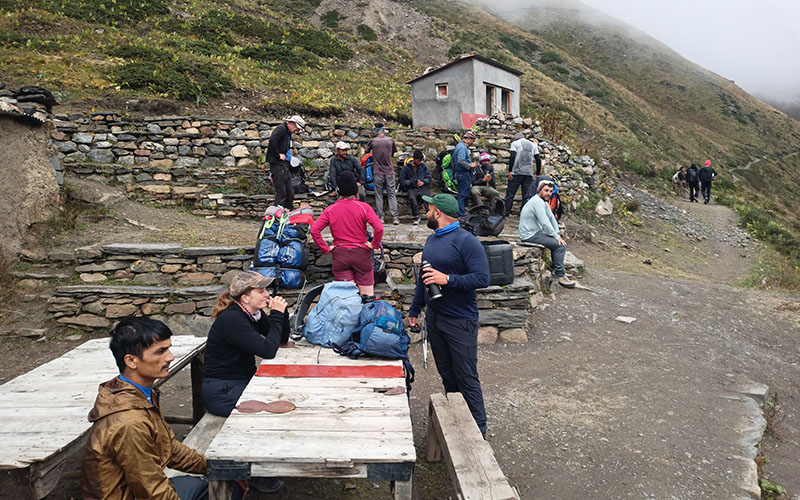
Budget $25-35 per day for a licensed guide and $18-25 per day for a porter, which most standard packages bundle into the total trip cost rather than billing separately. Independent trekkers hiring locally in Kathmandu or Pokhara should expect to pay within this range plus a daily food allowance for the guide and porter, since they eat and sleep in the same teahouses you do.
Tipping is customary and separate from the daily rate. Our guides suggest setting aside $150-200 total per trekker for end-of-trek tips split between guide and porter on a 12-18 day circuit – more if your group size is small and the workload per staff member is higher.
How much should I budget for food and lodging on the trail?
Teahouse rooms cost $3-10 per night at lower elevations and climb toward $8-15 near Manang and Thorong Phedi (4,540 meters / 14,895 feet), where everything is carried in by mule or porter. Meals run $5-8 for breakfast or lunch and $6-10 for dinner, with prices rising roughly 10-15% every few days as you climb higher.
- Dal bhat (rice, lentils, vegetables): $5-7, often with free refills – the most cost-efficient meal on the trail
- Basic noodle or soup dishes: $4-6
- Hot showers: $2-5 where available, often unavailable above Manang
- Wi-Fi and device charging: $2-5 per use, billed separately from the room
Most first-time trekkers underestimate the descent side of the circuit toward Muktinath and Jomsom, where jeep or bus fares back to Pokhara add another $15-30 depending on whether you choose local transport or a private vehicle.
How does Annapurna Circuit cost compare to Everest Base Camp?
The Annapurna Circuit is consistently the cheaper of the two treks, mainly because permit fees are lower and food costs less outside the Khumbu’s fly-in supply chain.
| Factor | Annapurna Circuit | Everest Base Camp |
| Mandatory permits | ~$25-30 (ACAP only) | ~$50 (Sagarmatha permit + local entry fee) |
| Standard guided cost | $1,200 – $1,800 | $1,800 – $2,400 |
| Food and lodging | Lower, road access to Besisahar | Higher, supplies flown or carried to Lukla |
| Typical duration | 12 – 18 days | 12 – 14 days |
If cost is your deciding factor between routes, our full Annapurna Circuit vs. Manaslu Circuit comparison breaks down how a similar-length alternative route stacks up on price and crowd levels too.
What hidden costs catch trekkers off guard?
The base package price rarely covers everything, and these are the extras our guides see trip up first-timers most often:
- Travel insurance with helicopter evacuation coverage: $80-150, and non-negotiable at altitude
- Extra nights in Kathmandu or Pokhara for delayed flights or acclimatization
- Battery charging and Wi-Fi fees at high-altitude teahouses, which can add $5-10 per day
- Hot showers above Manang, where they become inconsistent or unavailable
- Tips for guides and porters, which are expected but not included in package pricing
We’ve watched independent trekkers arrive with exactly the “average” budget quoted online, only to run short by Thorong La because they didn’t price in weather delays. Padding your total budget by 15-20% above whatever tier you’re planning around covers this without over-preparing.
How much cash should I carry, and where can I withdraw more?
Carry $600-800 in Nepali rupees for a standard 15-18 day circuit, since teahouses, porters, and guides are paid in cash almost everywhere on the trail.
ATMs exist in Besisahar, Chame, and Manang, but they run out of cash regularly during peak season (spring and autumn), so treat them as a backup rather than your primary plan. Withdraw what you need in Kathmandu or Pokhara before you start, ideally with a small buffer for the unexpected village shop purchase or extra pot of tea.
For a wider view of what a Nepal trekking budget looks like outside the Annapurna region specifically, our Nepal trekking cost guide covers regional cost differences in more depth.
Which cost tier is right for you?
| If you want… | Choose… | Expect to pay |
| Lowest possible cost, don’t mind basic rooms | Budget / DIY | $700 – $1,000 |
| A licensed guide, porter, and predictable planning | Standard guided | $1,200 – $1,800 |
| Private staff, better lodges, zero logistics stress | Full-service / private | $2,000 – $2,500+ |
Our guides recommend the standard tier for most first-time trekkers on the circuit – it’s the range where the guide requirement, permit processing, and weather-delay buffer are already handled, without paying for private-trek pricing you may not need. If you’re still deciding on timing, our best time to trek the Annapurna Circuit guide affects this budget too, since spring and autumn rates run 15-25% higher than the shoulder months.
Frequently Asked Questions
How much does the Annapurna Circuit trek cost?
A standard guided Annapurna Circuit trek costs $1,200-$1,800 per person for 12-18 days, covering permits, guide and porter fees, teahouse lodging, and most meals. Budget DIY trekking runs $700-$1,000, and full-service private treks reach $2,000-$2,500 or more.
Is the Annapurna Circuit cheaper than Everest Base Camp?
Yes. The Annapurna Circuit is generally $200-$400 cheaper than Everest Base Camp for a comparable guided trip, mainly due to lower permit fees and cheaper food and lodging outside the Khumbu’s fly-in supply routes.
Do I need a guide for the Annapurna Circuit in 2026?
Yes. Since 2023, Nepal has required a licensed guide for trekking above 3,500 meters in the Annapurna region, which covers most of the circuit. Solo trekking without a guide is no longer permitted here.
How much should I tip my guide and porter?
Budget $150-200 per trekker total, split between guide and porter, for a 12-18 day circuit. Tipping is customary in Nepal’s trekking industry and is separate from the daily guide and porter rates.
Can I trek the Annapurna Circuit on a tight budget?
Yes, a bare-bones DIY trek can run as low as $700-$1,000, but you’ll still need to budget for the mandatory ACAP permit, a licensed guide, and a 15-20% buffer for weather delays or extra nights in Pokhara or Kathmandu.
What’s the biggest cost mistake trekkers make on the Annapurna Circuit?
Underestimating extras: hot showers, Wi-Fi, and device charging above Manang, travel insurance with helicopter evacuation coverage, and tips. These rarely appear in advertised package prices but add up to $200-300 over the trek.
Get an Exact Quote for Your Annapurna Circuit Trek
Skip the guesswork – tell us your dates and trip style, and we’ll build a transparent, all-in cost breakdown with no hidden extras.