Choose Chitwan if you have 2-3 days, want near-certain one-horned rhino sightings and an easy 5-6 hour drive from Kathmandu. Choose Bardia if you can spare 4 days or more, want Nepal’s best realistic chance of seeing a wild Bengal tiger, and prefer a park that receives about one-tenth of Chitwan’s visitors.
Nepal’s two big lowland safari parks sit on the same Terai floodplain but deliver very different trips. Chitwan National Park is central, busy and built for short stays. Bardia National Park is far west, quiet and rewards patience.
This Chitwan vs Bardia comparison draws on the July 2026 national tiger census, current park fees and what our guides see on the ground. It is written for travellers adding a safari to a trek or cultural tour.
What is the difference between Chitwan and Bardia National Parks?
Both parks protect almost the same amount of lowland jungle, but Chitwan is the accessible, rhino-rich classic and Bardia is the remote, low-traffic tiger park. The practical differences are travel time, crowding and how you spend your safari hours.
| Chitwan National Park | Bardia National Park | |
| Location | South-central Terai; gateway village Sauraha | Far-west Terai; gateway village Thakurdwara |
| Size | 952.63 sq km (367.81 sq mi) | 968 sq km (374 sq mi) |
| Established | 1973 – Nepal’s first national park; UNESCO World Heritage Site since 1984 | 1988 – the largest national park in Nepal’s Terai |
| Tigers (2026 census) | 145 | 112 |
| One-horned rhinos (2021 count) | 694 | 38 |
| Bird species recorded | 543 | 407 |
| Visitors, fiscal year 2025/26 | 272,923 | 27,025 |
| From Kathmandu | 5-6 hours by road, or a 25-minute flight | 50-minute flight plus 2-3 hours by road |
| Foreigner entry fee | NPR 2,000 per person per day | NPR 1,500 per person per day |
| Best for | First safaris, families, short stays | Tiger tracking, walking safaris, repeat visitors |
Altitude is not a concern at either park. Chitwan’s valley floor sits at about 100 m (330 ft), rising to 815 m (2,674 ft) in the Sivalik Hills. Coming down from Kathmandu at 1,400 m (4,600 ft), expect heat and humidity instead.
Which park is better for seeing tigers, Chitwan or Bardia?
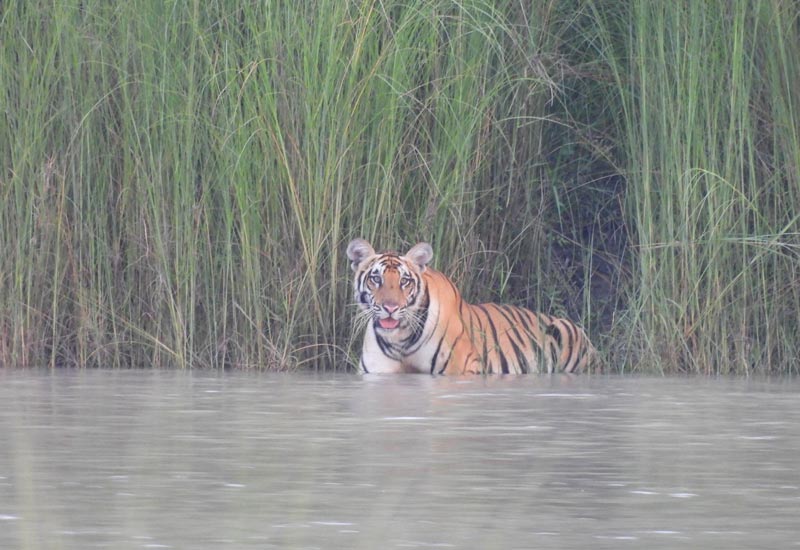
Bardia is the better bet for an actual sighting, even though Chitwan now holds more tigers. The national census released in July 2026 counted 145 tigers in Chitwan and 112 in Bardia.
Numbers alone do not put a tiger in front of your jeep. Bardia’s edge comes from how its safaris work:
- Open river habitat. The Karnali and Babai river systems give long sight lines at crossings and sandbanks.
- Full-day safaris. On foot or by jeep, guides wait quietly for hours at known crossing points.
- Few vehicles. With a tenth of Chitwan’s visitors, animals are less disturbed in daylight.
In Chitwan, camera-trap research has shown that tigers shift their activity away from daytime, when human presence peaks. Sightings do happen, but most visitors on a half-day jeep safari leave without one.
Guide tip: Our guides tell every guest the same thing before a Bardia safari: plan two full days inside the park, not one. A single day leaves too much to luck. The second day is usually when patience pays.
A word of honesty: no operator can guarantee a tiger, so treat any promised percentage with caution. Bardia’s count also fell from 125 to 112 between the 2022 and 2026 censuses – the only one of Nepal’s five tiger parks to record a decline.
Which park is better for rhinos, elephants and other wildlife?
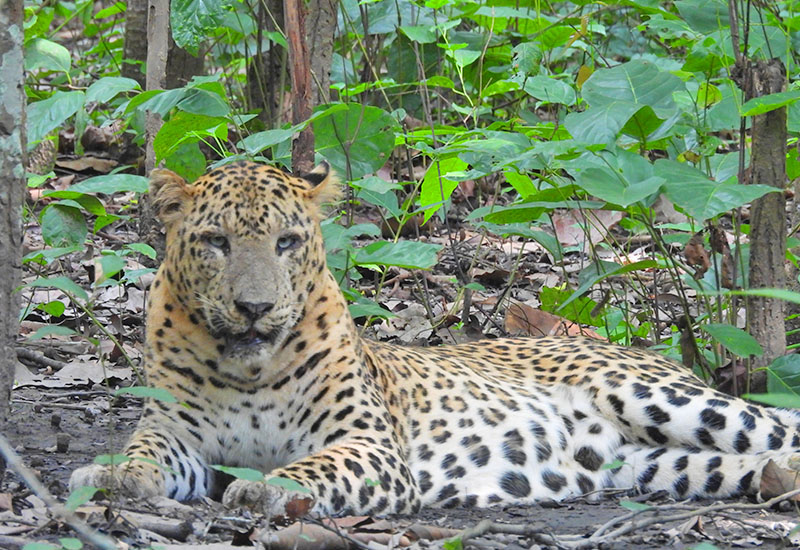
Chitwan wins clearly for rhinos and overall variety. Bardia wins for wild elephants and river wildlife.
Rhinos
Chitwan held 694 of Nepal’s 752 greater one-horned rhinos at the last national count in 2021. On a two-night stay around Sauraha, seeing one is close to certain – often from a canoe, or grazing at the forest edge at dusk.
Bardia had 38 at the same count, so treat a rhino there as a bonus. The count due in 2025 was postponed for lack of funding, so these remain the latest official figures.
Elephants and river life
Bardia’s wild elephant population is reported at around 120, and the Karnali River holds Gangetic dolphins and gharial crocodiles. Dolphin sightings are occasional, not routine.
Chitwan counters with 68 recorded mammal species against Bardia’s 53. That includes an estimated 200-250 sloth bears, plus gharial and mugger crocodiles along the Rapti and Narayani rivers.
Birds
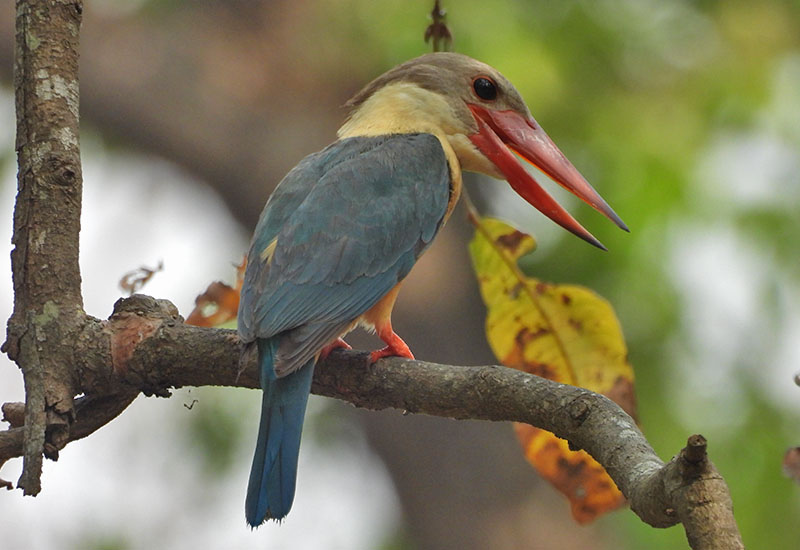
Chitwan’s checklist of 543 species is the longest of any protected area in Nepal. Bardia lists 407, including the critically endangered Bengal florican and the sarus crane. Winter, from December to February, brings migrants to both parks.
How do you get to Chitwan and Bardia from Kathmandu?
Chitwan is a 5-6 hour tourist bus ride or a 25-minute flight from Kathmandu. Bardia needs a 50-minute flight to Nepalgunj followed by a 2-3 hour drive, or 12-14 hours by road.
Reaching Chitwan
- Tourist coaches run daily from Kathmandu and Pokhara to Sauraha. A seat costs about USD 10.
- Flights land at Bharatpur, 30-45 minutes by road from Sauraha.
- The Mugling-Narayanghat section of the highway is prone to landslides and delays.
Between June and September, our guides treat 5-6 hours as a minimum, not an estimate, and avoid booking a same-day international departure.
Reaching Bardia
- Buddha Air runs around six daily flights from Kathmandu to Nepalgunj. Foreigner fares on booking sites in 2026 run at roughly USD 105-150 one way.
- From Nepalgunj airport it is about 90 km to Thakurdwara, usually 2-3 hours by private vehicle.
- Direct buses from Kathmandu take 12-14 hours. Most international visitors fly.
That transfer is why Bardia rarely works as a two-night add-on. Count one travel day in each direction.
Guide tip: Book the earliest Nepalgunj flight you can. An early arrival gets you to the lodge for lunch and an afternoon walk in the buffer zone instead of a lost day.
What safari activities can you do in each park?
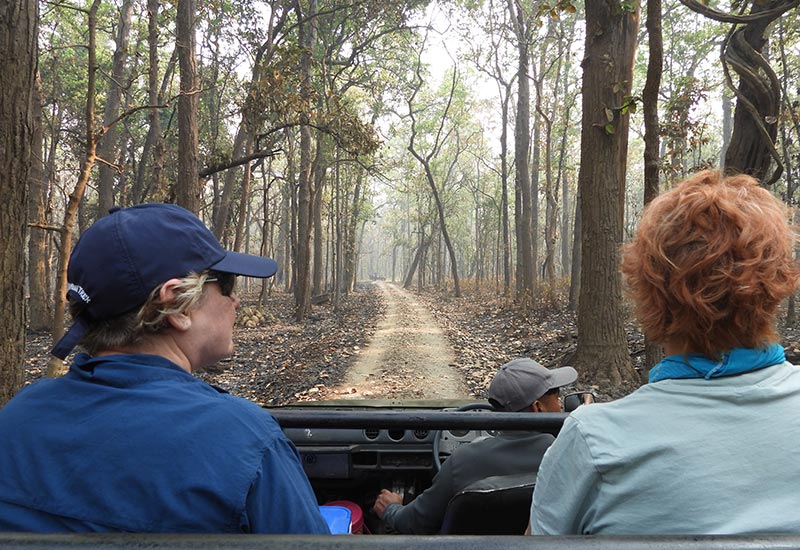
Both parks offer jeep safaris, guided jungle walks and river trips. Chitwan packs several short activities into a day, while Bardia builds whole days around one long safari.
| A typical Chitwan stay | A typical Bardia stay |
| Shared or private jeep safari, usually 4-5 hours | Full-day jeep safari with a packed lunch |
| Dugout canoe ride on the Rapti River | Full-day walking safari in tiger territory |
| Guided jungle walk and early-morning bird-watching | Rafting or boat trips on the Karnali River |
| Elephant Breeding Centre visit | Crocodile and elephant breeding centre visits |
| Tharu village visit and evening cultural show | Tharu village visit and cultural show |
Are walking safaris safe?
They carry real risk and deserve respect. You are on foot among tigers, rhinos, wild elephants and sloth bears. Licensed nature guides are mandatory in Bardia, and Chitwan’s rules forbid walking inside the park between sunset and sunrise.
Nepal’s rising tiger numbers have also brought more human-tiger conflict around both parks, which is why the rules are strict.
Our guides brief every walker before entering the forest: stay in single file, keep quiet, wear dull colours, and if a rhino charges, put a large tree between you and the animal.
Travelling with young children, or anyone unsteady on rough ground? Choose jeep and canoe safaris instead.
Is elephant riding still offered?
Elephant rides have not been allowed inside Chitwan National Park for nearly 15 years. They continue only in buffer-zone community forests around Sauraha.
In a verdict issued on 17 December 2025, with the full text published in July 2026, Nepal’s Supreme Court directed authorities to develop alternatives to elephant-back safaris on welfare grounds. Jeep, canoe and walking safaris show you the same wildlife without the ride, and demand from European visitors has already largely disappeared.
Is Chitwan too crowded, and is Bardia too remote?
Chitwan is busy around Sauraha but easy to escape, and Bardia is remote but far from basic. Both reputations are only half true.
Of Chitwan’s 272,923 visitors in fiscal year 2025/26, 237,025 entered through the Sauraha gate alone. In peak weeks that means jeep convoys and queues at the canoe landings.
The fix is simple. The park has nine entrance gates, and quieter ones such as Meghauli and Kasara see a fraction of that traffic. A full-day jeep safari also carries you well beyond the half-day circuit.
Bardia received 27,025 visitors in the same year, only 6,901 of them from outside South Asia. Thakurdwara still has more than 30 lodges and about 20 homestays, so comfort is not the issue – distance is.
How much does a safari cost in Chitwan vs Bardia?
Chitwan is the cheaper trip by a wide margin, mainly because you can drive there. A guided package including Kathmandu nights starts at about USD 599 per person for Chitwan and USD 1,499 for Bardia.
| Cost item | Chitwan | Bardia |
| Park entry, foreigners | NPR 2,000 per person per day (about USD 13) | NPR 1,500 per person per day (about USD 10) |
| Getting there from Kathmandu | Tourist bus, about USD 10 each way | Flight, roughly USD 105-150 each way, plus road transfer |
| Typical safari day | About USD 60 per person for a half-day jeep, canoe and walk including permit; around USD 100 for a full-day jeep | Around USD 150-190 for a full-day jeep safari |
| Guided package with Kathmandu nights | 6 days from USD 599 per person, twin share | 7 days from USD 1,499 per person, twin share |
Conversions use roughly NPR 152 to the US dollar. SAARC nationals pay NPR 1,000 in Chitwan, and each jeep entering Chitwan is charged NPR 5,000 – normally built into your safari price.
Prime Himalayas’ 6-day Chitwan wildlife safari covers two nights in Sauraha, park fees, canoe, jungle walk and jeep drive. The 7-day Bardia tiger tracking tour covers return Nepalgunj flights, three lodge nights and two full jeep safari days, which explains most of the price gap.
Park fees are set by the government and change with little notice. Sources also differ on whether 13% VAT is added to Bardia’s fee at the gate, so confirm current figures with your operator before you budget.
When is the best time to visit Chitwan and Bardia?
October to April is the main season for both parks, and March to May gives the best tiger and rhino sightings despite the heat. Mid-June to late September is monsoon, when some activities stop.
| Months | Conditions | Wildlife viewing |
| October-November | Clear, warm days after the monsoon; the busiest months | Good, but tall post-monsoon grass hides animals |
| December-February | Cool, often foggy until mid-morning; Chitwan nights drop to around 5 C (41 F) | Strong for birds and rhinos; slow early starts |
| March-May | Hot – Chitwan reaches about 36 C (97 F) and Bardia runs hotter | Best of the year: short grass, animals gather at water |
| Mid-June-September | Monsoon; Chitwan receives most of its roughly 2,500 mm (98 in) of annual rain | Limited; tracks flood and leeches are active |
Monsoon is not a write-off, but go in with open eyes. In August 2025, Bardia suspended jeep safaris to repair about 150 km of rain-damaged track. In the 2026 monsoon its tracks stayed open, yet the park logged just 294 visitors in the wettest month.
Conditions vary from year to year, so ask what is actually running before you book anything between June and September.
Winter has its own catch. December and January mornings are cold in an open jeep, so bring a warm layer and gloves for the first two hours. By 11 a.m. you will be down to a T-shirt.
Guide tip: If tigers are the priority, our guides point guests to late March through early May in Bardia. Nepalgunj, the gateway town, is known as Nepal’s hottest city, and it is uncomfortable by midday – which is exactly why animals come down to the river.
To see how these months line up with trekking seasons, read our guide to the best time to visit Nepal.
How many days do you need for each park?
Allow 3 days and 2 nights for Chitwan, and at least 4 days and 3 nights for Bardia, door to door from Kathmandu.
- Chitwan in 3 days: Day 1 travel and Tharu village walk. Day 2 canoe, jungle walk and jeep safari. Day 3 dawn bird-watching, then return.
- Bardia in 4 days: Day 1 fly and transfer. Days 2 and 3 full safari days. Day 4 return to Kathmandu.
Most first-time visitors underestimate how much of a Bardia trip is transit. Cut it to two nights and you get one safari day – too few for a park where patience is the whole point. Prime Himalayas’ Bardia itinerary allows three lodge nights for exactly this reason.
Trekkers have an easy fit with Chitwan. It lies between Pokhara and Kathmandu, so it slots in after an Annapurna Base Camp Trek without backtracking. Sore legs tend to appreciate a canoe.
What should you pack for a Nepal jungle safari?
Pack for blending in, not for style: dull colours, covered limbs and closed shoes. The same kit works in both parks.
- Long sleeves and trousers in green, brown or khaki. Leave white and bright red at the hotel.
- Closed walking shoes with grip for jungle walks and muddy riverbanks.
- Binoculars – the single item guests most often wish they had brought.
- Insect repellent, a sun hat and a refillable water bottle.
- Nepali rupees in cash for drinks and guide tips, which most packages exclude.
So which should you choose, Chitwan or Bardia?
Pick Chitwan for a short, affordable, high-certainty first safari. Pick Bardia if tigers and solitude matter more to you than convenience.
| If you are… | Choose | Why |
| On a first Nepal trip with 2-3 spare days | Chitwan | Short transfer, near-certain rhinos, varied activities |
| Travelling with children or older relatives | Chitwan | Shorter safari days, easy road access, far more lodges to choose from |
| Set on seeing a wild tiger | Bardia | Full-day safaris, open river habitat, few vehicles |
| A keen walker or photographer | Bardia | Long walking safaris and uncrowded sightings |
| A serious birder | Chitwan | 543 recorded species against 407 |
| Watching the budget | Chitwan | No flights needed; packages from USD 599 |
| Returning to Nepal after Chitwan | Bardia | A wilder, slower second safari |
The Chitwan vs Bardia decision usually comes down to time. With eight days or more you can do both, but the parks are a full day’s drive apart along the East-West Highway, so build in a travel day.
Families weighing options can also browse our best places to visit in Nepal with family. Prime Himalayas lists both itineraries under wildlife and safari in Nepal.
Frequently Asked Questions
Chitwan is better for most first-time visitors because it is 5-6 hours from Kathmandu, costs less and almost guarantees rhino sightings. Bardia is better if seeing a wild tiger is your main goal and you have at least 4 days.
Neither is objectively superior. In the Chitwan vs Bardia debate, the right answer depends on your time, budget and patience.
Yes, but do not count on it. Chitwan had 145 tigers in the 2026 census, the most of any park in Nepal, yet they are largely active outside daytime safari hours.
A full-day jeep safari deep into the park improves your odds over a half-day trip.
Not inside the national park, where rides stopped nearly 15 years ago. Elephant-back safaris still run in buffer-zone community forests near Sauraha.
A Supreme Court order published in July 2026 has told authorities to find welfare-friendly alternatives, so expect further change.
Walking safaris are generally well managed but never risk-free, because you share the forest with tigers, rhinos, elephants and sloth bears. Go only with licensed nature guides, follow their briefing exactly, and skip the walk with young children.
Yes, with at least eight days. Allow 2 nights in Chitwan, 3 nights in Bardia and a full travel day between them, or route back through Kathmandu and fly to Nepalgunj.
Foreign visitors pay NPR 2,000 per person per day at Chitwan and NPR 1,500 per person per day at Bardia – about USD 13 and USD 10. SAARC nationals pay NPR 1,000 at Chitwan.
Fees are paid in Nepali rupees at the gate or handled by your operator. Check current rates before travel.
Plan Your Nepal Safari with Local Guides
Tell us your dates and whether rhinos, tigers or both top your list.
Prime Himalayas will match you to Chitwan or Bardia and arrange permits, flights and licensed nature guides