
To trek to Everest Base Camp in 2026, you need two mandatory permits: the Sagarmatha National Park Entry Permit (NPR 3,000 / approx. USD 22 per person) and the Khumbu Pasang Lhamu Rural Municipality Entry Permit (NPR 2,000 / approx. USD 15 per person). A TIMS card is NOT required for EBC. Both permits can be arranged in Kathmandu before your trek or through your trekking agency.
The Everest Base Camp trek is one of the most iconic journeys on Earth – a 12 to 14 day trail through the Khumbu Valley in northeastern Nepal, rising from Lukla at 2,860 m (9,383 ft) to Everest Base Camp at 5,364 m (17,598 ft). Every year, thousands of trekkers from across the globe make this journey.
But before you set foot on the trail, you need the right permits. Without them, rangers at checkpoints in Monjo and throughout the Khumbu region will turn you back – no exceptions.
This guide gives you the complete, updated Everest Base Camp trek permit breakdown for 2026 – every document, every fee, every checkpoint, and every mistake to avoid. Our team at Prime Himalayas has helped hundreds of trekkers navigate this process, and everything we tell our clients is in this article.
What Permits Do I Need for the Everest Base Camp Trek in 2026?
You need exactly two permits to legally trek to Everest Base Camp in 2026:
| Permit Name | Issuing Authority | Cost (2026) | Where to Get |
| Sagarmatha National Park Entry Permit | Department of National Parks (DNPWC) | NPR 3,000 (~USD 22) | Kathmandu or Monjo gate |
| Khumbu Pasang Lhamu Rural Municipality Permit | Khumbu Pasang Lhamu Rural Municipality | NPR 2,000 (~USD 15) | Lukla or Monjo |
Important: A TIMS card (Trekkers’ Information Management System) is NOT required for the Everest Base Camp trek. The Sagarmatha National Park and Khumbu Rural Municipality permits fully cover your entry into the Khumbu region. Many outdated travel blogs still list TIMS as required for EBC – this is incorrect for 2026.
What Is the Sagarmatha National Park Entry Permit?
The Sagarmatha National Park Entry Permit is the primary and most important document for the Everest Base Camp trek. Sagarmatha National Park is a UNESCO World Heritage Site covering 1,148 sq km in the Solukhumbu District of Nepal, encompassing the entire Khumbu Valley – the approach route to Everest.
Sagarmatha National Park Permit Fee 2026
| Trekker Category | Fee (NPR) | Fee (Approx. USD) |
| Foreign nationals | NPR 3,000 | ~USD 22 |
| SAARC nationals (India, Pakistan, Bangladesh, etc.) | NPR 1,500 | ~USD 11 |
| Children under 10 years | Free | Free |
Where to Get the Sagarmatha National Park Permit
You have two options:
- In Kathmandu – recommended: Visit the Department of National Parks and Wildlife Conservation (DNPWC) office at Babar Mahal, Kathmandu. Open Sunday to Friday, 10 AM to 5 PM. Bring your passport, one passport photo, and cash in Nepali Rupees. Your trekking agency can collect it on your behalf – which is what Prime Himalayas does for all EBC clients.
- At the Sagarmatha National Park entrance gate in Monjo: The gate is at Monjo village (2,835 m / 9,301 ft), about a 3.5-hour walk from Namche Bazaar. Rangers issue permits here, but queues during peak season (March-May, October-November) can be 45 minutes to 2 hours long. Cash in NPR is required.
Pro Tip: Always arrange the Sagarmatha National Park permit in Kathmandu before flying to Lukla. If your permit is not ready and the Monjo gate has a long queue, it delays your entire group and puts your acclimatisation schedule at risk.
What Is the Khumbu Pasang Lhamu Rural Municipality Permit?
The Khumbu Pasang Lhamu Rural Municipality Entry Permit – often called simply the Khumbu permit or local municipality permit – is a newer mandatory document introduced to fund local infrastructure development in the Khumbu region.
Many trekkers arriving with older information miss this permit entirely. As of 2024 and continuing into 2026, it is checked at the same Monjo checkpoint and at additional points further up the trail toward Namche Bazaar.
Khumbu Pasang Lhamu Rural Municipality Permit Fee 2026
| Category | Fee (NPR) | Fee (Approx. USD) |
| All foreign trekkers | NPR 2,000 | ~USD 15 |
| SAARC nationals | NPR 1,000 | ~USD 7.50 |
| Children under 10 years | Free | Free |
Where to Get the Khumbu Pasang Lhamu Permit
- At the Khumbu Pasang Lhamu Rural Municipality office in Lukla (2,860 m / 9,383 ft) – available when you land
- At the Monjo entry checkpoint – rangers issue both permits at the same location
- Through your trekking agency in Kathmandu before the trek – the most reliable option
Our guides at Prime Himalayas always obtain both permits for clients in Kathmandu. The combined cost is NPR 5,000 (approx. USD 37) per person – a small fraction of your total Everest Base Camp trek cost.
Where Are Everest Base Camp Trek Permits Checked?
Rangers check your permits at multiple points along the EBC route. Knowing where these checkpoints are helps you understand why having both permits ready before you start is essential.
| Checkpoint Location | Altitude | What Is Checked |
| Monjo village | 2,835 m / 9,301 ft | Sagarmatha National Park permit + Khumbu Rural Municipality permit |
| Namche Bazaar | 3,440 m / 11,286 ft | Permit spot-checks common at tea houses and police posts |
| Tengboche | 3,867 m / 12,687 ft | Occasional ranger checks on both permits |
| Lobuche | 4,940 m / 16,207 ft | Police post check – both permits required |
| Gorak Shep | 5,164 m / 16,942 ft | Final checkpoint before Everest Base Camp |
Ranger Advice: Our guides report that Monjo is the strictest checkpoint – rangers cross-check permit names against your passport and verify the Khumbu Rural Municipality permit specifically. Keep physical copies of both permits, not just phone photos. At higher elevations, some rangers still prefer to see the original documents.
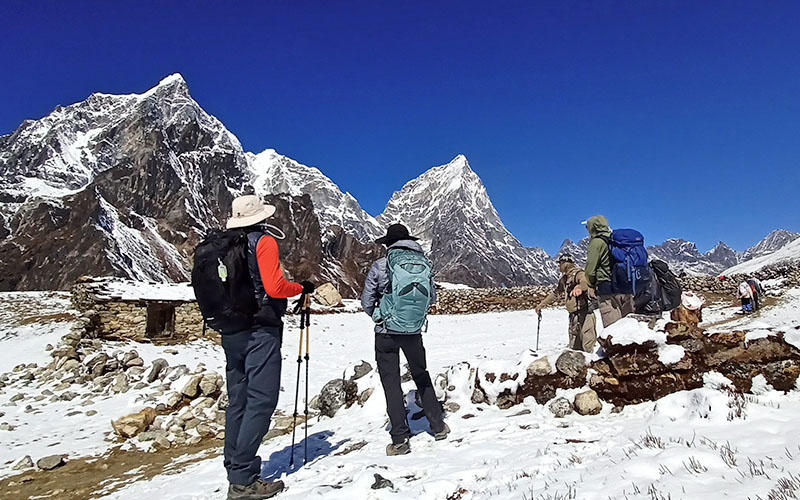
Do I Need a Licensed Guide to Trek to Everest Base Camp in 2026?
Yes. Since April 2023, the Government of Nepal mandates that all foreign trekkers in the Everest, Annapurna, and Langtang regions must trek with a licensed Nepali guide. This regulation applies to the Everest Base Camp trek.
What This Means for Your Permits
- Solo trekking without a guide is no longer legally permitted on the EBC route
- Your guide must be licensed by the Nepal Tourism Board and registered with the Department of Tourism
- Your trekking agency is responsible for verifying guide credentials
- Permit applications submitted through a registered agency automatically comply with this regulation
For context on what this means for your overall planning, our article on solo trekking to Everest Base Camp covers the regulation in detail, including what ‘guided’ means in practice for independent-minded trekkers.
How Do I Get Everest Base Camp Trek Permits Step by Step?
Here is the exact process to obtain your EBC permits in 2026:
- Book your trek with a registered Nepali trekking agency. This is the simplest and most reliable route. The agency collects permits on your behalf in Kathmandu. Prime Himalayas handles all EBC permit paperwork as part of our standard trek package.
- If applying independently, visit the DNPWC office at Babar Mahal, Kathmandu. Bring your original passport, one passport-sized photo, and the permit fee in NPR cash. The office processes permits on the same day in most cases.
- Collect the Khumbu Pasang Lhamu Rural Municipality permit. This can be obtained at the same time in Kathmandu through your agency, or at Lukla on arrival.
- Keep both permits safe throughout the trek. Use a waterproof document sleeve. Rangers will handle your permits at each checkpoint – keep them accessible, not buried in your pack.
- Carry Nepali Rupees as backup. If a permit needs to be renewed or an additional fee arises at a remote checkpoint, card payments are not available. ATMs exist in Namche Bazaar but can run out of cash in peak season.
What Is the Total Permit Cost for the Everest Base Camp Trek in 2026?
Here is a complete permit cost summary for a foreign national trekking EBC in 2026:
| Permit | Cost (NPR) | Cost (Approx. USD) |
| Sagarmatha National Park Entry Permit | NPR 3,000 | ~USD 22 |
| Khumbu Pasang Lhamu Rural Municipality Permit | NPR 2,000 | ~USD 15 |
| TIMS Card | NOT required | NOT required |
| Total Permit Cost | NPR 5,000 | ~USD 37 |
This USD 37 total covers only the permit fees. Your actual EBC trek budget will also include guide and porter fees, teahouse accommodation, flights to and from Lukla, travel insurance, gear, and food. Most trekkers spend between USD 1,200 and USD 2,500 total for a 12 to 14 day EBC trek, depending on the level of service and group size.
Do EBC Permit Fees Change by Season in 2026?
No. The Sagarmatha National Park permit and Khumbu Pasang Lhamu Rural Municipality permit are the same price year-round – NPR 3,000 and NPR 2,000 respectively. There is no seasonal pricing difference for EBC permits in 2026.
However, the best seasons to trek Everest Base Camp are:
- Spring (March to May): Most popular season. Clear skies, warmer temperatures, rhododendron blooms. Expect busier trails and teahouses at Gorak Shep and Lobuche.
- Autumn (September to November): Second most popular. Excellent visibility after monsoon, stable weather. October is widely considered the single best month for EBC.
- Winter (December to February): Cold but possible. Temperatures at Base Camp can drop to -20 degrees Celsius. Fewer crowds, lower teahouse rates, but some high passes may be icy.
- Monsoon (June to August): Not recommended. Heavy rainfall, trail erosion, leeches below Namche, and poor visibility on the mountain approaches.
Planning Tip: If you are trekking in peak spring or autumn, arrange your permits at least 2 to 3 weeks before departure. In October especially, DNPWC queues in Kathmandu can be long. Your agency can handle this remotely once you confirm your itinerary.
What Are the Most Common EBC Permit Mistakes in 2026?
Our field guides at Prime Himalayas see these permit errors regularly – on the trail and at the Kathmandu office:
- Arriving at Monjo without the Khumbu Rural Municipality permit. This is the most common mistake. Many trekkers have the Sagarmatha National Park permit but forget this second document. Rangers will not let you pass without it.
- Relying on a phone photo of the permit. Some rangers at remote checkpoints above Namche Bazaar do not accept digital copies. Always carry physical originals in a waterproof sleeve.
- Not carrying Nepali Rupees. All permits must be paid for in NPR cash if purchased at the gate. Monjo has no ATM. The nearest ATM is in Namche Bazaar, which you reach after the checkpoint.
- Using an incorrect permit name. Your permit must match the name in your passport exactly. Spelling errors from rushed in-office applications have caused delays at checkpoints. Double-check before leaving Kathmandu.
- Assuming last year’s permit is still valid. Permits are single-entry and expire. A permit from a previous trek is worthless at a 2026 checkpoint.
- Trekking without a registered guide. Since April 2023, solo trekking without a licensed Nepali guide is not permitted on EBC. Attempting to do so risks being turned back at Monjo.
Do I Need Extra Permits for EBC Side Treks Like Gokyo or Three Passes?
The standard EBC permits (Sagarmatha National Park + Khumbu Rural Municipality) cover most of the Khumbu Valley routes, including common extensions. Here is a breakdown:
| Side Trek / Extension | Additional Permit Needed? | Notes |
| Kala Patthar (5,645 m) | No | Covered by standard EBC permits |
| Gokyo Lakes via Gokyo Ri | No | Within Sagarmatha National Park |
| Three Passes Trek (Kongma La, Cho La, Renjo La) | No | All within SNP boundary |
| Island Peak climbing (6,189 m) | Yes – Climbing Permit | USD 250-350 per person from Ministry of Tourism |
| Lobuche Peak climbing (6,119 m) | Yes – Climbing Permit | USD 250 per person from Ministry of Tourism |
If you plan to add a climbing peak to your EBC itinerary, the climbing permit must be obtained separately from the Ministry of Culture, Tourism and Civil Aviation in Kathmandu. Prime Himalayas handles these as part of combined EBC and peak climbing packages.
Frequently Asked Questions: Everest Base Camp Trek Permit 2026
You need two permits: the Sagarmatha National Park Entry Permit (NPR 3,000 / approx. USD 22) and the Khumbu Pasang Lhamu Rural Municipality Entry Permit (NPR 2,000 / approx. USD 15). A TIMS card is not required for EBC. Total permit cost for a foreign national is NPR 5,000 (approx. USD 37).
The most reliable option is through a registered Nepali trekking agency in Kathmandu before your trek. You can also obtain the Sagarmatha National Park permit at the DNPWC office in Babar Mahal, Kathmandu, or at the Sagarmatha National Park gate in Monjo. The Khumbu Pasang Lhamu permit is available at Lukla or at the Monjo checkpoint. Both are free to purchase through your agency as part of the trek arrangement process.
No. A TIMS card is not required for the Everest Base Camp trek in 2026. The TIMS card is required for treks in other regions such as Langtang, Helambu, and Tamang Heritage Trail. For EBC, only the Sagarmatha National Park permit and the Khumbu Pasang Lhamu Rural Municipality permit are mandatory.
You can technically get both permits on arrival – either in Kathmandu or at the Monjo entry gate. However, we strongly recommend arranging them before your trek begins in Kathmandu. During peak season (March-May and October-November), queues at the Monjo gate can take 1 to 2 hours, disrupting your trekking schedule and acclimatisation plan.
The Sagarmatha National Park permit is valid for the duration of your trek within the park. It is a single-entry permit tied to your trek dates. If you exit and re-enter the park – for example, if you extend your trip or return from a side excursion – you would need to purchase a new permit. Most standard EBC itineraries do not require this.
Children under 10 years of age are exempt from both the Sagarmatha National Park permit fee and the Khumbu Pasang Lhamu permit fee. Children aged 10 and above pay the same rate as adult foreign nationals. It is worth noting that the EBC trail is strenuous and high-altitude – most trekking operators recommend a minimum age of 12 to 14 for EBC, depending on the child’s fitness and experience.
Ready to Trek to Everest Base Camp?
Let Prime Himalayas Handle Every EBC Permit For You Forget the paperwork. Our Kathmandu-based team secures your Sagarmatha National Park permit, Khumbu Pasang Lhamu Rural Municipality permit, and Lukla flight bookings – so you arrive at the trailhead ready to walk, not worried about checkpoints. the adventure.